Unique Paths
LeetCode 62 | Difficulty: Medium
MediumProblem Description
There is a robot on an m x n grid. The robot is initially located at the top-left corner (i.e., grid[0][0]). The robot tries to move to the bottom-right corner (i.e., grid[m - 1][n - 1]). The robot can only move either down or right at any point in time.
Given the two integers m and n, return the number of possible unique paths that the robot can take to reach the bottom-right corner.
The test cases are generated so that the answer will be less than or equal to 2 * 10^9.
Example 1:
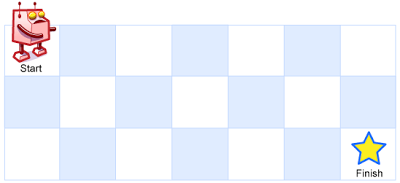
Input: m = 3, n = 7
Output: 28
Example 2:
Input: m = 3, n = 2
Output: 3
Explanation: From the top-left corner, there are a total of 3 ways to reach the bottom-right corner:
1. Right -> Down -> Down
2. Down -> Down -> Right
3. Down -> Right -> Down
Constraints:
1 <= m, n <= 100
Topics: Math, Dynamic Programming, Combinatorics
Approach
Dynamic Programming
Break the problem into overlapping subproblems. Define a state (what information do you need?), a recurrence (how does state[i] depend on smaller states?), and a base case. Consider both top-down (memoization) and bottom-up (tabulation) approaches.
Optimal substructure + overlapping subproblems (counting ways, min/max cost, feasibility).
Mathematical
Look for mathematical patterns or formulas. Consider: modular arithmetic, GCD/LCM, prime factorization, combinatorics, or geometric properties.
Problems with clear mathematical structure, counting, number properties.
Solutions
Solution 1: C# (Best: 48 ms)
| Metric | Value |
|---|---|
| Runtime | 48 ms |
| Memory | N/A |
| Date | 2018-03-06 |
public class Solution {
    public int UniquePaths(int m, int n) {

 int[,] dp = new int[m,n];
	for (int i = 0; i < m; i++)
	{
		for (int j = 0; j < n; j++)
		{
			if(i==0|| j==0) dp[i,j] = 1;
			else dp[i,j] = dp[i-1,j]+dp[i,j-1];
		}
	}
	return dp[m-1,n-1];
}
}
Complexity Analysis
| Approach | Time | Space |
|---|---|---|
| DP (2D) |
Interview Tips
- Discuss the brute force approach first, then optimize. Explain your thought process.
- Define the DP state clearly. Ask: "What is the minimum information I need to make a decision at each step?"
- Consider if you can reduce space by only keeping the last row/few values.